
“Our BI-42 warmed to 46°F during a hot Alta Heights afternoon while the freezer stayed at 1°F. The technician checked condenser airflow first, then found the fresh-food evaporator fan stalled. The OEM motor repair was $610, finished in 2.5 hours, and rechecked at 37°F.”
4.9/5 network rating372 verified repairs
Core service · Napa, CA 94558
Sub-Zero Repair in Napa — the full appliance family, one specialist
When a Sub-Zero built-in, wine column or freezer in a Napa kitchen stops holding temperature, the cause is rarely obvious from the front display. It could be a condenser coil packed with dust or pet hair — a problem Silverado and Alta Heights homes see most after a hot-summer condenser load — or a door gasket leak creating condensation or a frost line at the door frame, or sealed-system suspicion requiring EPA-regulated verification. Napa Sub-Zero Repair is an independent Sub-Zero specialist for Napa. Use Book Online with the Sub-Zero model number and we will tell you what we expect to find before the truck leaves your neighborhood.
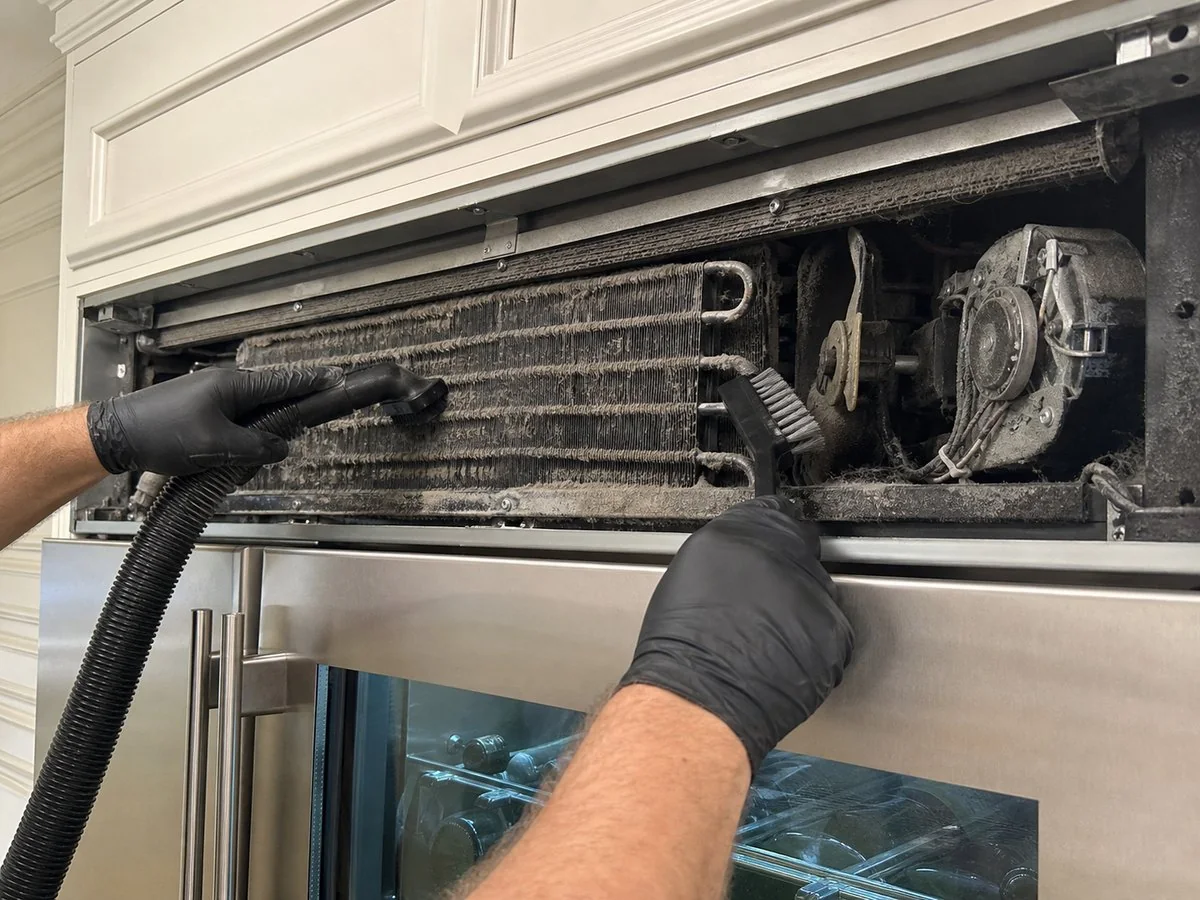
Two problems that look simple but aren't
Door gasket leaks, condensation, and condenser coil load — what the diagnosis actually confirms
Door gasket leak: condensation and frost line explained
A Sub-Zero door gasket is a magnetic, multi-layer seal that compresses against the cabinet face when the door closes. When it ages, flattens, tears, or loses its magnetic pull, warm room air migrates into the cold interior constantly — not just when you open the door. That humid air hits the cold evaporator surface and the interior walls, and you see the result as condensation on the door frame, sweating at the hinge corner, or a frost line running along the edge of the door.
In plain terms: a gasket leak is a slow, invisible open door. The box compensates by running the compressor more, but it can never fully catch up because the infiltration is continuous. Sub-Zero gaskets are model-specific in profile, material stiffness and magnetic strength — a generic replacement may seal visually but fail within months because the compression geometry does not match the OEM spec.
What diagnosis confirms: we check the seal around the full perimeter with a calibrated thermometer and a visual inspection of the gasket profile under light. We check hinge alignment and door drop, which can look identical to a failed gasket from outside but is fixed differently. What cannot be known before inspection: whether a second fault — a warped door frame, a failing hinge, or a cabinet alignment issue — is also contributing to the symptom.
Condenser coil packed with dust or pet hair — the Napa summer factor
The Sub-Zero condenser is located at the top of the unit (older built-ins) or behind the lower grille (current models). Its job is to shed the heat pulled from the interior into room air. When the coil fins are packed with dust or pet hair — which accumulates faster in Napa homes with dogs, cats, or open-air patios — the coil cannot shed heat efficiently. The compressor runs hotter and longer, head pressure rises, and the box slowly drifts warm.
During a Napa summer, when ambient temperatures in neighborhoods like Silverado and Alta Heights regularly exceed 95°F, a partially blocked condenser creates what we call a hot-summer condenser load problem: the thermal margin between the refrigerant circuit and the room is already thin, and even a modest restriction tips the balance. A box that holds temperature fine in January may run 8°F warm by August — and the entire fix is condenser service.
If cleaning the condenser does not resolve the symptom within a few hours of run time, the problem is mechanical: an evaporator fan, a frosted evaporator, a thermistor, a damper, or — when both sides are affected — a sealed-system concern.
One limitation
A warm box can have more than one contributing factor. A dirty condenser and a marginal evaporator fan may both need attention. We report every finding, not just the loudest one.
Full product coverage
Sub-Zero appliance families we service in Napa — and the failure each sees most often
Sub-Zero's lineup spans eight distinct product families, each with its own sealed-system architecture, control board generation and service access requirements. The table below pairs each family with the failure pattern it shows most often in Napa homes.
| Appliance family | Representative models | Most common Napa failure | Service access note |
|---|---|---|---|
| BI-Series Built-In | BI-36U, BI-48SID, BI-30UG | Refrigerator-side evaporator fan or frosted evaporator; fresh-food warm while freezer still holds | Condenser at top behind grille; back panel for evaporator — tight in cabinet runs |
| Integrated (panel-ready) | IT-30, IT-36, IW-30 | Door gasket compression failure behind a panel-ready door; condensation mistaken for a plumbing issue | Custom panels must be removed before gasket or hinge work — plan for additional time on site |
| Classic Series | 632, 636, 650, 736TFI | Condenser coil packed with dust or pet hair, especially in older homes with tight grille clearance | Older grille designs may require the unit to be eased forward for full condenser access |
| Designer Series | DET3050, DET4550, DEU2450 | Thermistor drift causing temperature inconsistency; control board faults on older generation units | Control boards are generation-specific — model-tag serial range determines the correct board revision |
| PRO 48 / PRO 36 Columns | PRO 4850G, PRO 3650W | Ice maker fill-tube frost or weak fill valve; dual-zone temperature divergence between compartments | Front-access service; columns install flush and may need partial pull-out for compressor area access |
| Freezer Columns (all-freezer) | BI-36F, F-36, SCOF30 | Excessive frost build-up due to defrost heater or timer failure; door gasket leak in below-zero zone | Evaporator at rear; requires door removal and back-panel access — allow additional visit time |
| Wine Columns & Dual-Zone | IW-30, BW-24, 424, 448W | Temperature drift off set point; door gasket leak causing humidity swings; thermistor misread | Zone-by-zone temperature verification required; fan and thermistor checks per zone before quoting |
| Undercounter (fridge & wine) | UC-24RG, UC-24W, AHT24 | Condenser overload in enclosed cabinetry; door gasket seal failure in undercounter island installs | Ventilation clearance is often the root cause — confirmed before component diagnosis begins |
Not sure which family your unit belongs to? The model & serial guide shows how to read the model string and what it tells you about your unit's architecture and part generation.
Napa installation reality
How Browns Valley, Alta Heights, downtown Napa and Coombsville shape the repair
Sub-Zero repair in Napa is not generic appliance work. The neighborhoods here — their home ages, cabinetry styles, kitchen orientations and climate microclimates — change what a technician needs to plan for before arriving.
Browns Valley
Remodeled ranch and farmhouse kitchens in Browns Valley often have Sub-Zero units built into cabinet runs designed around an older model. The openings may be too narrow for a current replacement, so repair almost always wins economically here. Condenser grilles in these installs frequently face a wall or shallow alcove, restricting the airflow that keeps the coil from overloading on hot afternoons — clearance is checked before blaming the coil itself.
Alta Heights
Hillside homes in Alta Heights have west-facing kitchens that absorb significant afternoon heat through large windows, raising the ambient temperature around the refrigerator by mid-afternoon. A condenser coil packed with dust or pet hair becomes a real problem here rather than a maintenance note: the thermal margin is already thin in summer, and even partial restriction tips the balance. Airflow checks are the first stop on every warm-unit call.
Downtown Napa
Downtown Napa homes range from early 1900s Victorians to recent infill builds near the Oxbow Public Market. Older homes often have Sub-Zero units retrofitted into kitchen remodels with non-standard panel depths and custom cabinetry, making door alignment and gasket replacement more involved than a straightforward swap. Appliance age tends to be higher in this area, meaning control boards and sealed systems may be from a legacy generation requiring OEM parts sourced from older stock.
Coombsville
Rural Coombsville properties — many of them wine-country estates or second homes — present a different service challenge: units that run unmonitored for days or weeks between visits. A gasket that starts leaking or a condenser that begins to overheat may go unnoticed until the damage to a wine collection or food is already significant. We confirm the box is holding verified temperatures before leaving — not just a set-point display — because no one is watching until the next visit.
Also serving Silverado, Yountville, St. Helena and American Canyon (ZIP 94558, 94559). Up-valley bookings are scheduled with a morning arrival window to allow for drive time and full diagnostic time on site.
How a visit runs
The diagnostic sequence — what we test, in what order, and why each step matters
Every Sub-Zero diagnostic follows the same sequence because skipping steps produces wrong quotes. Here is the exact order and what each step confirms or eliminates.
1
Model and serial confirmation on site
Before opening a panel we re-read the model and serial tag on the unit. Sub-Zero uses the serial range to determine which control board revision, fan motor spec and gasket profile applies — the same model name can span multiple part generations that take different components.
2
Visual inspection — condenser, gasket perimeter, frost patterns
We inspect the condenser coil for dust and pet-hair restriction, check the door gasket for tears, flattening and lost magnetic pull around the full perimeter, and look for condensation or frost patterns that indicate where warm air is entering. This eliminates the two most common low-cost causes before any panel is removed.
3
Temperature and airflow readings
We log actual temperatures in both the fresh-food and freezer sections — or both wine zones on a dual-zone column — and measure evaporator surface temperature. We verify that the evaporator fan is moving air at the correct volume. The numbers tell us whether the problem is heat-rejection (condenser side) or heat-absorption (evaporator side): two very different repairs.
4
Electrical and mechanical check
We meter the evaporator fan motor, defrost heater, thermistors and control board outputs. On units with active error codes, we read stored codes before clearing them. We verify that the compressor starts, runs and builds pressure rather than cycling short — which distinguishes a mechanical start issue from a sealed-system refrigerant loss.
5
Part verification and OEM confirmation
We match the failed component's specification against the OEM part number for your model and serial range. If a part was brought on the truck based on the phone intake, we confirm it is correct before opening the packaging. If the needed part was not anticipated, we provide a lead time and schedule the return visit — we do not fit an incorrect part because the right one was unavailable.
6
Written flat quote — your approval before work begins
Every repair is quoted as a flat rate in writing. You approve the number before we touch a part. The diagnostic fee ($150–$225) is credited in full toward the repair you approve. If the diagnosis reveals that repair is uneconomical for your unit, we tell you that plainly — and you owe only the diagnostic fee.
7
Repair with OEM parts
We install the OEM component, re-seal any panels opened during diagnosis, and restore door gasket compression if gasket work was performed. For sealed-system repairs, EPA-regulated refrigerant handling procedure is followed throughout — we do not shortcut a regulated process. Our technicians hold EPA Section 608 Universal certification; how a certified sealed-system bill is built explains what that changes on the worksheet.
8
Post-repair temperature verification
After the repair we let the unit run and re-read temperatures in both compartments before leaving. You receive the before-and-after readings in writing — documented proof the box is holding, not just a closed door and a set-point display.
What we will not guess
When both compartments run warm and sealed-system suspicion is raised, we do not estimate the repair cost at the door. Sealed-system suspicion that needs EPA-regulated verification requires temperature readings, condenser and evaporator photos, model-tag proof and OEM part evidence before a quote is written. We will tell you whether the evidence supports a sealed-system diagnosis — we will not recommend a $1,200–$2,900+ repair on a hunch. See the sealed system and compressor page for the full explanation of what that process involves.
Evidence-first approach
What a real Sub-Zero diagnosis looks like — the evidence we check and document
A Sub-Zero specialist differs from a general appliance call in what gets checked and what gets written down. Here is the evidence trail on every Napa visit:
- Temperature readings: actual fresh-food and freezer readings logged before and after the repair, not the set-point display value — because the display can lie when a thermistor faults.
- Condenser and evaporator photos: we document the condenser coil condition (dust load, fin damage, debris type) and the evaporator surface (frost pattern, fan condition) so the written quote reflects what was actually observed.
- Model-tag proof: the tag is confirmed and the serial range cross-referenced before any OEM part is matched — two units with the same model name can take different control board revisions.
- OEM fan, gasket, control-board evidence: we show the part number match between the failed component and the OEM replacement, not a generic substitute that meets the surface spec but not the engineering tolerance.
- Sealed-system suspicion that needs EPA-regulated verification: when a sealed-system issue is possible, we document the pressure readings and temperature differential that support or rule out that diagnosis. EPA-regulated work is a required step, not an upsell.
This documentation matters because a Sub-Zero is designed to run for decades. Knowing exactly what was replaced and why gives you a record if a related symptom appears years later — and gives you the basis for an honest repair-vs-replace conversation if multiple faults develop over time. To see what those records look like in practice, browse our anonymized Napa case notes.
Warranty and process note
Every repair carries a 90-day parts-and-labor process warranty. If the repaired component fails within that window, we return and address it at no additional charge. This applies to the specific part and failure mode repaired — it does not cover unrelated faults that develop after the visit. Terms are provided with the written quote.
Honest Napa ranges
Pricing and repair economics — what Sub-Zero service actually costs in Napa
These ranges reflect what repairs cost in Napa — not a teaser rate that climbs once the technician arrives. Every job is confirmed with a written flat quote before work begins. The diagnostic fee applies in full toward the repair you approve.
Diagnostic visit
$150–$225
Full model/serial confirmation, visual inspection of condenser and gaskets, temperature readings, electrical and mechanical checks, and a written repair estimate. Credited toward the repair in full.
Common repairs
$340–$950
Evaporator fan motor, defrost heater or timer, thermistor, damper assembly, control board, door gasket, ice-maker module or fill-tube defrost. OEM parts included in the flat quote.
Sealed system
$1,200–$2,900+
Compressor replacement or refrigerant leak work. EPA-regulated, labor-intensive. Quoted only after sealed-system suspicion is confirmed with EPA-regulated verification — never on a hunch.
Repair vs. replace — the Napa context
A replacement Sub-Zero built-in — once you account for the appliance, installation, cabinet modification, panel work and millwork — typically runs $9,000 to $18,000 or more in Napa. That is why repair is the economical choice for the vast majority of faults, including most sealed-system work. The cases where replacement makes financial sense are limited: a unit that is very old and has experienced simultaneous major failures across multiple systems, or a cabinet opening that can no longer support the unit structurally.
We give you an honest read on your specific unit and situation. If replacement is the better call, we will say so clearly. See the full repair-vs-replace decision framework →
What moves the quote within these ranges: which Sub-Zero series you own, whether the part is current production or legacy stock, condenser access complexity in your cabinet run, and whether a primary fault has caused a secondary component to fail simultaneously.
Real-world scenario Illustrative — not a claimed completed job
What a typical Napa wine-column call looks like from intake to verification
A homeowner in Coombsville notices their Sub-Zero wine column has drifted from its 55°F set point to 62°F over three days. The display still reads 55°F. They call Monday morning with the model number — a 424 dual-zone — and note the unit has been in the home for about eleven years.
At intake, a thermistor fault on this generation produces exactly this symptom: the display reports the set point because the control board trusts the sensor reading, but the actual zone temperature has climbed because the thermistor resistance has drifted out of spec. We schedule for the same afternoon and bring an OEM thermistor matched to the 424 serial range as the most likely needed part.
On site: model and serial confirmed on the tag. Visual inspection clear — condenser coil is clean, door gasket makes full contact around the perimeter, no error codes stored. Actual temperature reading of the lower zone: 63°F vs. 55°F displayed. Thermistor resistance reading is out of the published range for this serial. Written flat quote approved. OEM thermistor installed. Post-repair reading: 54.8°F in the lower zone after 40 minutes of run time. Before-and-after readings provided in writing with the invoice.
This is an illustrative scenario based on the type of calls we receive for Sub-Zero wine columns in Napa. It does not represent a specific completed job or guarantee of outcome for your unit — actual diagnosis is required.
Sub-Zero repair in Napa — questions answered
What people ask before booking a diagnostic visit
How do I know if my Sub-Zero needs a condenser cleaning or a real repair?
A condenser coil packed with dust or pet hair is one of the most common and lowest-cost causes of a warm Sub-Zero in Napa — especially after a hot-summer condenser load period. The box runs warm, the compressor cycles long, and the temperature slowly climbs. If cleaning the condenser (accessible behind the lower grille on most models) does not restore normal temperatures within a few hours of run time, there is likely a deeper mechanical cause — an evaporator fan, a frosted evaporator or a sealed-system issue — that needs a technician's readings to confirm. We check the condenser first on every visit and report every finding before recommending anything further. See also the not-cooling diagnostic guide for the full decision tree.
What does a door gasket leak actually do to a Sub-Zero?
A door gasket leak lets warm, humid air enter the cabinet continuously — not just when you open the door. You will see condensation or a frost line along the door frame, and the unit works harder to hold temperature, stressing the compressor over time. On a wine column in Napa, even a small gasket leak can cause temperature swings that affect a collection within a day or two. Diagnosis identifies whether the gasket itself has failed, the door is misaligned, or the hinge has dropped — all three produce the same visible symptom but require different fixes. What cannot be known before inspection: whether a second fault is also contributing to what you are seeing.
When does a Sub-Zero repair require EPA-regulated sealed-system work?
Sealed-system suspicion that needs EPA-regulated verification arises when both compartments run warm, the compressor runs but produces no cooling, or refrigerant loss is suspected. Federal law requires EPA certification for anyone who opens a sealed system or handles refrigerant. We confirm this with temperature readings, condenser and evaporator photos, model-tag proof and OEM part evidence before quoting — we do not recommend sealed-system work on a hunch. The diagnostic visit ($150–$225, credited toward repair) is the only honest path to that answer. Full details on the sealed system and compressor page.
Which Sub-Zero models do you service in Napa?
We service the full Sub-Zero lineup: BI-series built-in units, integrated panel-ready models, Designer series, Classic series, PRO 48 and PRO 36 columns, all-freezer columns, wine columns and dual-zone wine units, and undercounter refrigeration and wine storage. Each product family has its own service access requirements — PRO columns require front-access service, wine columns need zone-by-zone temperature verification, and older Classic-series units may need to be eased forward for condenser access. The technician verifies model and serial on-site number and we will tell you what we expect before the visit.
How does Napa's summer heat affect a Sub-Zero, and does it change the repair?
Napa's summer heat — regularly above 95°F in neighborhoods like Silverado and Coombsville — places extra load on the condenser, which must shed heat into already-warm room air. A condenser coil partially blocked by dust or pet hair becomes far less effective under these conditions. The result is elevated head pressure, a compressor running hotter and longer, and a box that climbs above its set point by mid-afternoon. This hot-summer condenser load pattern is why condenser condition is the first check on any warm-unit call during summer months. In some cases it is the entire repair; in others it reveals a secondary issue that the partial blockage was masking.
What is included in the diagnostic visit, and is the fee applied toward the repair?
The diagnostic visit ($150–$225) includes model and serial confirmation, full visual inspection of the condenser, evaporator, door gaskets and fans, actual temperature readings from both compartments, electrical and mechanical checks on fans, thermistors and control board outputs, and a written flat-rate quote for the repair. The diagnostic fee is credited in full toward any repair you approve. No work begins without your written approval. If the diagnosis reveals that repair is not economical, we tell you plainly — and you owe only the diagnostic fee. Reach us at the call / book page or use Book Online.
Ready to schedule Sub-Zero service?
Call (628) 209-6820 or book online to schedule a diagnostic window. The technician verifies model, serial, temperatures and repair evidence at the appliance before the written quote.
Related symptom
If the box is not cooling at all, the not-cooling diagnostic guide walks through the full decision tree — from evaporator fan to sealed-system — before you call.
Technical depth
For sealed-system and compressor questions — what EPA-regulated work involves, when it is warranted, and how the quote is built — see the sealed system & compressor page.
Start here
New to the site? The home page has the symptom router, diagnostic sequence overview, and the most common questions people ask before deciding to call.
Local reviews
Napa whole-appliance repair reviews with exact fault and verification
4.9/5 network rating372 verified repairs
“The unit sat unused between visits and both sections were drifting when we arrived. They documented 49°F fresh food, 18°F freezer, heavy condenser dust, and fan amperage before quoting. Cleaning and fan verification stayed within the $225 diagnostic, and temperatures recovered by evening.”
“Our 600-series built-in had a door alarm and a visible frost line near the lower hinge. The tech protected the floor, adjusted the panel-ready door, and installed the serial-matched gasket. The $485 repair took under 2 hours and stopped the alarm the same day.”
Service desk: 1300 First Street, Suite 368, Napa, CA 94559. Visits are scheduled by appointment; call before stopping by.