Skip to content
Napa Sub-ZeroAppliance Repair

Symptom guide · Napa, CA

Sub-Zero freezer not freezing in Napa

A freezer that won't get cold is a different fault from a fridge that won't cool — different side of the cabinet, different parts, different repair. This guide is for the freezer side: soft ice cream, a warm freezer drawer, ice that sweats, or a frost wall building behind the panel.

4.9/5 · 1,101 verified customer reviews

Technician reading the temperature inside a built-in Sub-Zero freezer compartment in a Napa kitchen

When a Sub-Zero stops keeping food frozen, the temptation is to call it "not cooling" and brace for a compressor bill. But a warm freezer with a still-cold refrigerator is usually telling you something far more specific: the failure is on the freezer side of the cabinet, and on most built-in Sub-Zeros that side has its own evaporator, its own fan and its own defrost cycle. Naming which of those quit is the whole job, and it rarely starts with the sealed system.

We see this most in two Napa situations. The first is the freezer left full and untouched through a vacant off-season — a Carneros or Coombsville second home where the owners leave in autumn, the box quietly slips into a defrost fault over winter, and nobody notices until the spring visit reveals a freezer of thawed-and-refrozen food. The second is the overflow freezer banished to a garage or out-building, running through valley-floor summer heat that no indoor unit ever sees. Both fail in recognizable ways, and both are usually a bounded repair once we read the evidence.

Which side is actually failing

Freezer not freezing vs fridge not cooling

The fastest way to point a technician at the right part is to tell us which compartment is warm. These two patterns look similar from the front but resolve very differently.

Reading the two compartments against each other
What you observeLikely side & causeWhere to read next
Freezer warm/soft, fresh food still coldFreezer-side evaporator fan, defrost heater/thermistor, or a frosted freezer evaporatorThis page
Fresh food warm, freezer still frozenFridge-side evaporator, damper or air pathNot-cooling diagnostic
Both sections drifting warm togetherShared condenser load, condenser fan, or sealed systemSealed system & compressor
Warm freezer plus a frost line at the doorGasket air leak letting humid valley air inDoor gaskets & seals

Layout matters

Column freezer vs drawer freezer — different failure modes

Full-height freezer column (700 series)

A dedicated freezer column carries its own complete refrigeration circuit, so when it warms there is no cold fresh-food side to compare against. The usual suspects are the evaporator fan motor, a defrost heater or sensor that has stopped clearing frost, and on the oldest units a tired compressor. Because collectors in Silverado and Browns Valley often pair these with a fridge column, we check both circuits so one warm box doesn't mask a second weak one.

Bottom drawer-freezer (BI-36 / BI-42 / BI-48)

On a built-in with a fresh-food top and a freezer drawer, the two compartments are linked by airflow and a damper. A warm drawer can mean the freezer evaporator iced over, but it can equally be a damper or air-path problem starving the drawer of cold air while the top stays fine. That distinction changes the part and the price, so we verify it on site rather than assume.

Defrost faults and the frost wall

The most common reason a Sub-Zero freezer goes warm without the compressor ever failing is the defrost system. Every freezer builds frost on its evaporator; a healthy unit melts it on a timed or adaptive cycle using a small defrost heater, watched by a thermistor and a control. When the heater opens, the thermistor drifts, or the control loses the cycle, frost stops clearing and slowly sheets the evaporator in ice. Airflow chokes, the fan pushes against a wall of frost, and the box warms even though refrigerant is still moving.

The tell is a heavy frost wall behind the rear freezer panel while the air feels warm — often with a freezer that recovers for a day or two after a manual thaw, then softens again. That recurring soften-and-recover rhythm is the defrost signature, and in a Napa second home it can repeat for weeks before anyone is there to catch it. It is a bounded, stocked-part repair: a defrost heater, a thermistor, sometimes the control. What it is not is a reason to open the sealed system, and chipping at that ice to "help" is the fastest way to puncture an evaporator and turn it into one.

When it really is the sealed system

Sometimes the freezer is the early warning of genuine sealed-system trouble — a weak compressor or a slow refrigerant leak that shows up first as a freezer that can't hold 0°F. The honest signs are a freezer that warms steadily with a clean condenser, a working fan and no frost wall, and a compressor that runs continuously without pulling the box down. Even then we don't quote refrigerant work from symptoms; under Section 608 that work is regulated, and it gets diagnosed with pressure and temperature evidence and confirmed in a written quote first. If your unit is older, the repair-or-replace framework and what sealed-system work costs are worth reading before you decide.

Before you call

Five checks that speed up the repair

  1. Read the freezer temperature, not the display. Put a probe thermometer between frozen packages overnight. A Sub-Zero freezer should hold near 0°F; a reading of 10–20°F that the front panel still calls fine is the single most useful number to give us before we drive out to your Napa kitchen.
  2. Confirm the fresh-food side separately. Check whether the refrigerator compartment is still cold. A cold fridge with a warm freezer points squarely at the freezer-side evaporator, fan or defrost circuit — a different repair branch than both sides drifting together.
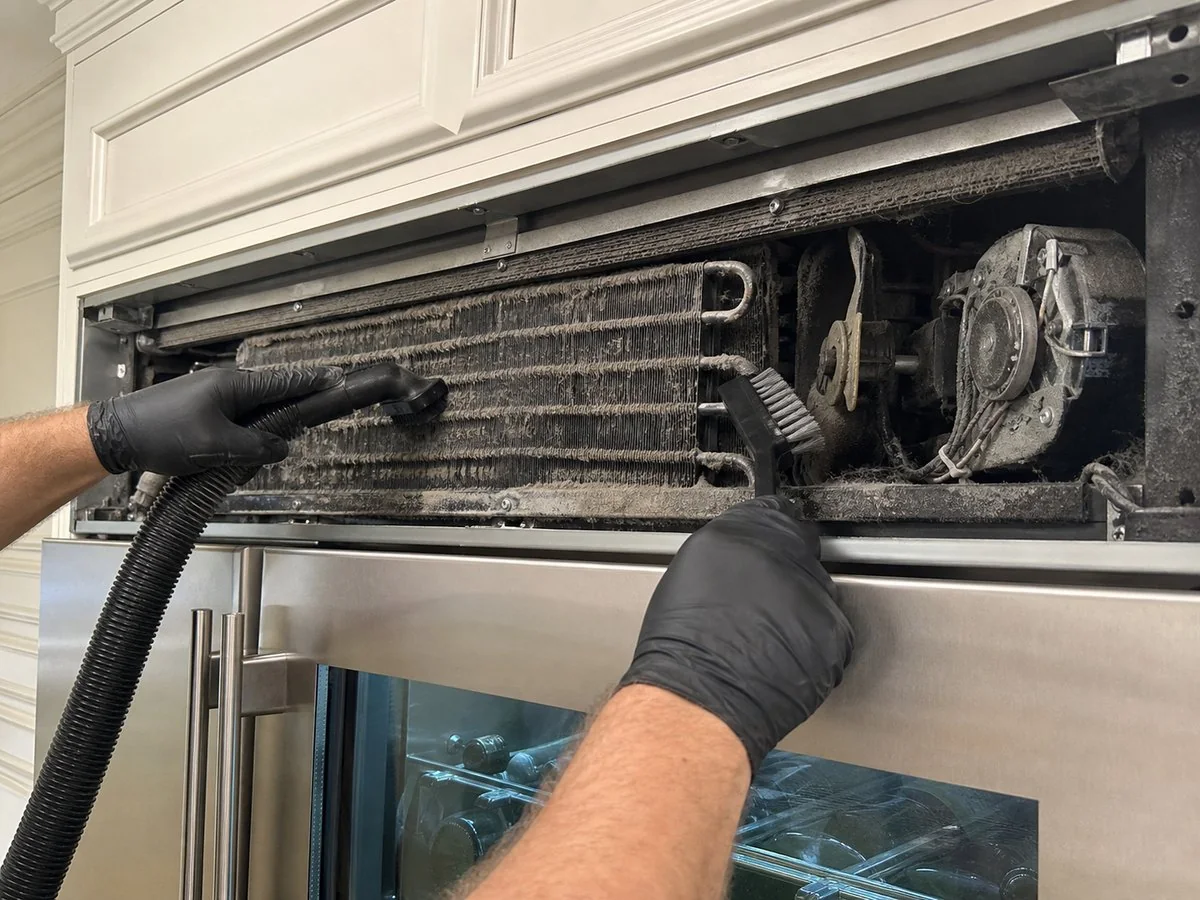
  3. Look and listen at the lower grille. Pull the grille and check the condenser for the vineyard dust and pet hair that load up fast on the valley floor. Listen for the condenser fan; a silent fan or a coil packed solid raises freezer temperature on a hot afternoon.
  4. Check for a frost wall behind the freezer panel. If the back interior panel is sheeted in heavy frost or ice while the air still feels warm, the defrost system has likely quit and the evaporator has frozen over. Note it, but do not chip at it — a punctured evaporator turns a bounded repair into a sealed-system job.
  5. Note the timeline and the load. Tell us when it started and what the freezer was doing — full and untouched through a vacant off-season, slammed during harvest hosting, or a garage backup running in summer heat. The pattern narrows the cause before a technician arrives.

Freezer questions

Sub-Zero freezer not freezing — Napa FAQ

My Sub-Zero fridge is cold but the freezer is warm — what's the difference from a not-cooling fridge?

They are opposite sides of the cabinet and usually different parts. A warm freezer with a cold fresh-food section points at the freezer-side evaporator fan, the defrost heater or thermistor, or a frosted-over freezer evaporator — not the refrigerator circuit. Our not-cooling diagnostic covers the fridge-side pattern; if it's the freezer that won't get cold, this page is the right branch. We confirm which side is failing with actual probe readings before quoting a part.

Does a Sub-Zero column freezer fail differently than a drawer freezer?

Yes. A full-height freezer column (a 700-series unit) leans on a single freezer evaporator and its defrost cycle, so a stuck defrost or a failed evap fan warms the whole column. Bottom drawer-freezers on a built-in like a BI-36 share airflow with the fresh-food side through a damper, so a warm drawer can trace to that damper or to airflow starvation rather than the sealed system. We diagnose the two layouts differently.

The freezer keeps softening every few days in our Napa second home — why?

A freezer that recovers and then softens on a cycle is the classic defrost-fault or marginal-evaporator pattern, and it is easy to miss in a property that sits unwatched between visits. By the time someone arrives the box may have warmed and refrozen several times. Coombsville and up-valley second homes get this a lot; tell us the home sits empty so we can verify the box actually holds before we leave.

Is a warm freezer always an expensive sealed-system repair?

No — and that's why we read evidence first. Most warm-freezer calls in Napa resolve as a bounded fix: an evaporator fan motor, a defrost heater or thermistor, a stuck damper, or a loaded condenser. True sealed-system failure — a weak compressor or refrigerant leak — is rarer and only quoted after pressure and temperature evidence, never from the front display.

Freezer warm? Let's confirm the side before ordering parts.

Tell us the freezer reading and whether the fresh-food side is still cold, and you'll get a written price before any work begins. Same-day visits are often available across Napa and up-valley.